• instagram (5)
  • 65e82dd72e92827394
  • 65e82dd7a74e048637
  • 65e82dd83039430728
Leave Your Message

What Are the Top Water Current Meters for Global Buyers?

Choosing the top Water Current Meter for global buyers requires more than comparing prices or advertised velocity ranges. Rivers differ sharply. A shallow irrigation channel behaves unlike a deep, sediment-heavy estuary. Temperature, conductivity, turbulence, submerged debris, and operator skill can change field results within minutes.

John Herschy, a respected hydrologist and author of Hydrometry, offered a practical principle: “Good hydrometry begins with understanding the river, not merely operating the instrument.” That principle remains valuable today. Propeller meters suit many routine discharge surveys. Electromagnetic meters perform well where moving parts could clog. Acoustic Doppler systems provide detailed profiles, especially in deeper or faster water. Optical instruments may help in difficult access conditions, but visibility becomes a serious limitation.

This guide compares leading options through real purchasing concerns: calibration traceability, measurement range, sensor durability, data logging, battery life, software compatibility, and regional service support. A reliable meter should arrive with clear documentation and calibration evidence. ISO/IEC 17025 laboratory support adds confidence, although certification alone cannot guarantee perfect field data.

Small details matter. A loose connector can interrupt a survey during heavy rain. A bright display helps beside muddy water. Spare cables may matter more than a sophisticated menu. No shortlist is perfect. Buyers should still test shortlisted instruments in representative conditions before placing large international orders. This step is sometimes skipped, and regrettably so. The best Water Current Meter is not always the most advanced model. It is the one that produces repeatable, defensible measurements where the work actually happens.

What Are the Top Water Current Meters for Global Buyers?

Water Current Meters: Definition, Purpose, and Main Measurement Principles

Water current meters measure the speed and direction of moving water. They support discharge surveys, flood studies, irrigation checks, and environmental monitoring. A meter converts water movement into a readable signal. Depending on its design, it may use a rotating propeller, electromagnetic sensing, ultrasonic pulses, or acoustic Doppler shifts. Each principle responds differently to depth, debris, turbulence, and suspended sediment. That matters to global buyers working in canals, rivers, ports, and open channels.

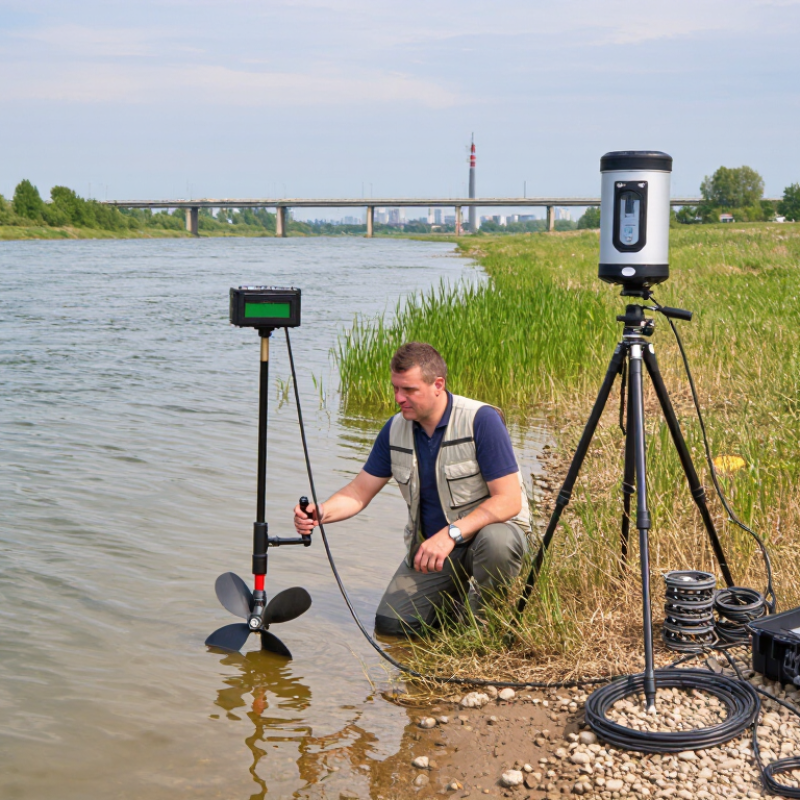
Mechanical propeller meters remain practical in clear water and controlled sections. Their rotation rate relates to velocity through a calibration equation. Electromagnetic meters detect voltage created as conductive water crosses a magnetic field. They perform well at low speeds, but electrical noise and poor contact can affect readings. Ultrasonic transit-time meters compare travel times between sound paths. Acoustic Doppler instruments estimate velocity from frequency changes in particles carried by the flow. They cover larger profiles, yet need careful positioning and adequate scatterers.

Choosing among the top water current meters starts with the measurement task, not the sales label. Check velocity range, minimum depth, temperature limits, cable length, data storage, and calibration records. Field teams should repeat readings and compare them with site conditions. A clean display does not guarantee accurate data. Small alignment errors can distort a profile. No instrument is perfect. Buyers should also consider training, spare parts, local service, and regional reporting requirements. Results become more defensible when operators record water level, cross-section details, and uncertainty beside every survey.

How to Compare Accuracy, Range, Portability, and Data Recording Features

Choosing a water current meter requires more than checking a headline accuracy figure. In field surveys, accuracy depends on calibration, water quality, turbulence, and operator technique. Ask for the stated error range, calibration certificate, and test conditions. A meter reading within 1% in a laboratory may perform differently near a muddy riverbank.

Range also matters. Small streams need sensitive sensors that measure slow movement without excessive drift. Deep channels require longer measurement reach and stable readings across changing velocities. Portability can shape field productivity. A lightweight meter, compact case, and simple mounting system reduce fatigue during repeated measurements. Still, the lightest option is not always the best. Fragile parts may suffer during transport.

Data recording features deserve close inspection. Look for internal memory, time-stamped readings, exportable files, and clear battery information. A bright display helps when sunlight reflects on the water. Wireless transfer is useful, but it should not replace local storage. Connections fail.

From practical testing, I would also check how quickly the instrument responds to sudden flow changes. Some devices appear precise but average readings too slowly. That weakness can hide short bursts around rocks, gates, or bridge supports. Buyers should compare warranty terms, replacement sensors, and calibration service availability in their region. No meter is perfect. Field notes and repeated measurements remain essential, especially when readings seem unexpectedly clean.

Top Water Current Meter Types for Rivers, Coasts, and Open-Ocean Surveys

Rivers, Coasts, and Open-Ocean Surveys

Choosing the right water current meter depends on flow speed, depth, suspended sediment, and deployment time. In rivers, mechanical propeller meters remain practical for wading surveys and bridge measurements. They are simple, affordable, and easy to inspect. However, debris can slow the rotor or produce misleading readings. Electromagnetic meters suit shallow, turbulent channels because they have no moving parts. They need careful positioning near rocks and changing riverbeds.

Acoustic Doppler current profilers measure water movement across several depths. They work well from boats, fixed platforms, and autonomous survey systems. Coastal teams often use them where tides, waves, and salinity change quickly. Open-ocean surveys usually require compact acoustic profilers with strong battery control and reliable pressure housings. Optical sensors can help in clear water, but muddy estuaries may reduce their usefulness. No instrument is perfect. Even advanced systems can struggle with bubbles, vessel motion, or weak acoustic reflections.

Tips: Match the sensor range to expected velocities, not average conditions. Check calibration before deployment and after harsh fieldwork. Record temperature, salinity, depth, and mounting angle with every survey. A clean signal does not always mean accurate data. Compare a new meter with a trusted reference during early deployments. This extra step takes time, but it can expose installation errors before they affect an entire survey.

What Are the Top Water Current Meters for Global Buyers?

Representative current-speed measurement ranges for common water current meter types used in rivers, coastal waters, and open-ocean surveys. Actual limits vary by sensor configuration, sampling mode, water conditions, and deployment depth.

Propeller meters

Common in rivers and canals where a single-point velocity reading is required.

Electromagnetic meters

Useful in shallow, low-speed flows and locations with suspended sediment or vegetation.

Acoustic Doppler profilers

Best suited to profiling velocity through river channels, estuaries, and coastal water columns.

Acoustic Doppler velocimeters

Designed for high-resolution point measurements in laboratories, nearshore zones, and turbulence studies.

Chart values are representative engineering ranges in metres per second (m/s), compiled from commonly published operating ranges for these instrument categories rather than from any specific manufacturer.

Key Selection Criteria for Global Buyers and Different Field Conditions

Choosing the best water current meter depends on field conditions, not popularity. A clear mountain stream needs different equipment from a tidal estuary. Check the expected velocity range, water depth, temperature, and salinity before comparing models. A meter should measure slow movement without losing accuracy during sudden flow increases. It also needs suitable mounting for boats, bridges, wading rods, or fixed stations.

Sediment can scratch sensors and distort readings. In muddy rivers, select a robust sensor with simple cleaning access. Saltwater work demands corrosion-resistant materials and careful sealing. Cold regions require batteries that perform reliably near freezing temperatures. Ice and floating debris create additional risks. They may damage exposed components. A protected design is often more valuable than a higher advertised measurement range.

Reliable purchasing also requires calibration records, clear uncertainty data, and practical operating instructions. Ask whether replacement cables, batteries, and sensor parts are available in the destination country. Data logging matters during long surveys, especially when cellular service is weak. Confirm the file format before field deployment. Small compatibility problems waste hours.

Field experience changes expectations. A meter can perform well in a laboratory yet struggle beside a turbulent bank. Operators should compare repeated readings and record water depth, weather, and mounting angle. No instrument removes every human error. That is easy to forget. Global buyers should review local safety rules, service access, and training needs before selecting equipment. A slightly less advanced meter may produce better results when crews can maintain and use it confidently.

Global Standards, Calibration Needs, Maintenance, and Purchasing Considerations

What Are the Top Water Current Meters for Global Buyers?

For global buyers, top water current meters are not chosen by speed range alone. Acoustic Doppler meters suit deep or uneven channels, while electromagnetic and rotating-element meters remain practical in smaller sections. The WMO Guide to Instruments and Methods of Observation, No. 8, stresses traceable calibration, documented uncertainty, and field verification. ISO 748 supports velocity-area measurement procedures, including the familiar 0.6-depth point method for shallow, regular flows. Simple methods still matter.

Calibration should match water temperature, conductivity, sediment load, and expected velocity. ISO 2537 addresses rotating-element current meters and their performance testing. A procurement specification should request calibration certificates, test conditions, serial-level records, and uncertainty values—not just “high accuracy.” USGS Techniques and Methods 3-A13 recommends checking equipment condition and measuring-site suitability before discharge work. Small errors grow when cross-sections are poorly defined. That is often overlooked.

Maintenance is operational, not cosmetic. Rinse probes after sediment-rich deployments, inspect cables and seals, and check rotor bearings before storage. Keep raw measurements, firmware versions, operator notes, and repair history together. The WMO State of Global Water Resources 2023 reported that only about half of countries have adequate hydrological data, making reliable instruments more valuable. Yet advanced meters are not automatically better. Battery life, local service capacity, spare sensors, and training may determine the real cost. Laboratory-only confidence can mislead; turbulent rivers may expose weaknesses that a clean flume never reveals.